The main consumables to proceed with the robots or by hand are supplied by the facility (plates, seals, tips, etc).
There is however not an extensive range of chemicals and stock solutions stored in the facility.
Shared benches are available for basic procedures with samples, stock solutions and crystals.
Plates are stored and assessed in the inner room 1S239 (18°C), which integrates two microscopes equipped with cameras.
There is an additonal room 1S230 for experimentation at 10°C with another Mosquito and microscope.
Equipment for flash-freezing and shipping crystals is also available in 1S239.
The MRC 96-well original crystallisation plates containing the initial screens are routinely prepared in-house on a fully automated system (Tecan Evo liquid-handler with integrated plate carousel and sealer) from commercially available kits of conditions in test tubes.
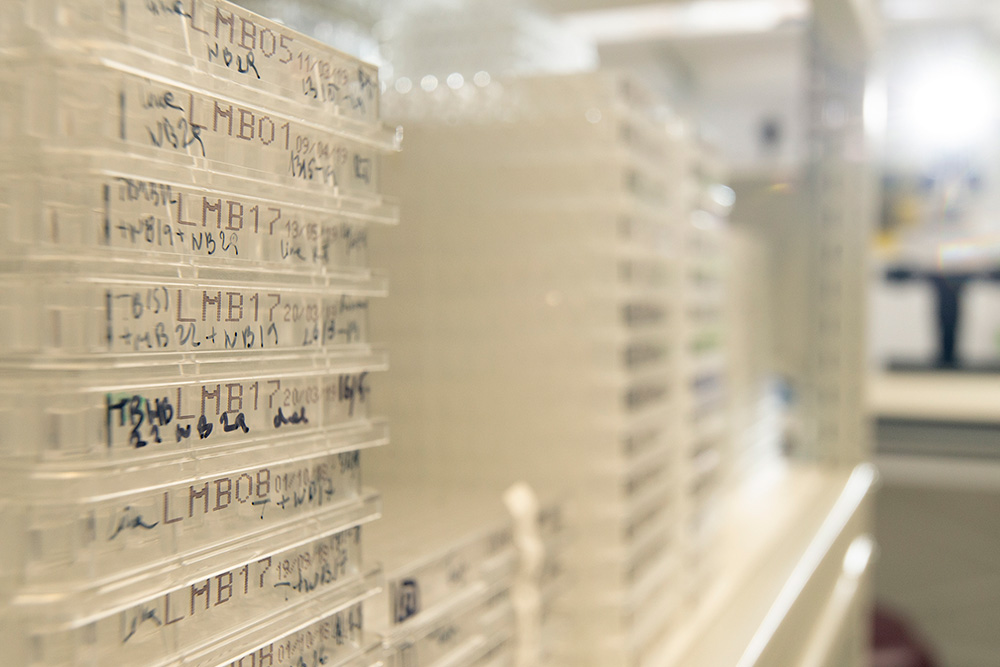
The main incubator (10°C) is a screen bank with a broad variety of these ready-to-use initial screens (called 'LMB plates’).
Crystallisation droplets are setup with nanolitre dispensing MOSQUITO robots (SPT Labtech).
The common approach is to set up single drops of 200 nL final volume with 1:1 ratio (100 nL protein + 100 nL condition).
Standard optimisation screens are prepared according to the method '4-corner solutions: Linear gradients of concentrations are produced directly into the reservoirs of a plate with the Dragonfly liquid-handlers (SPT Labtech).
MAXI plates (48 wells) and the corresponding automated protocols are also available for scale-up experiments (up to 10 µL drop size).
Some additive screens are available in frozen low profile and deep-well blocks (in the under-bench freezer).
Last Updated 10/04/26