
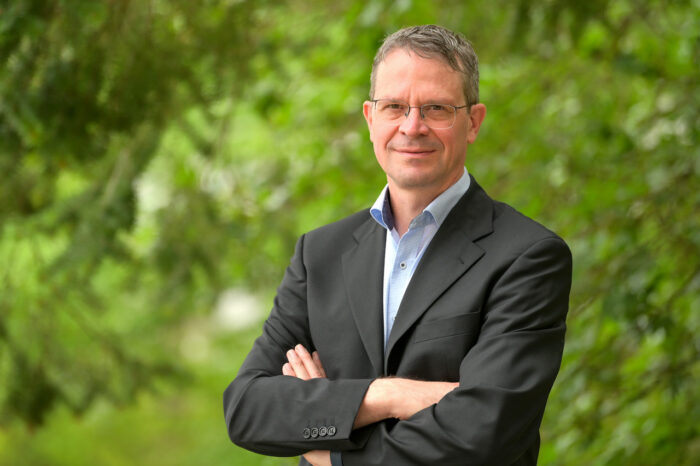
Dirk Görlich will deliver the 2026 Max Perutz Lecture at 11:00am (GMT) in the LMB’s Max Perutz Lecture Theatre on the 19th January 2026. The talk, titled ‘Transport through nuclear pores’ will also be streamed via Zoom, where anyone interested is welcome to join.
Dirk Görlich is a Director at the Max Planck Institute for Multidisciplinary Sciences in Göttingen, Germany, where his group investigates the cellular systems behind nuclear-cytoplasmic transport. More specifically, he researches how nuclear pore complexes operate as efficient transportation machines, and how this system can be hijacked by certain viruses or potentially used to deliver therapeutic interventions.
Dirk has spearheaded several advancements in our understanding of intercellular transport, including the discovery of importins and exportins, which act as shuttles carrying cargo through nuclear pores. His group later developed the RanGTP-gradient model, explaining how cells use a chemical signal to ensure correct direction and energy flow of cargo transportation. More recently, his group have identified that nuclear pores aren’t just holes, but in fact possess barriers comprised of FG domains which are highly selective and permeable, ensuring only the correct molecules can pass. Additionally, his group have demonstrated how they can harness nanobodies to serve as tiny, cellular tools for use as therapeutic interventions in diseases such as Covid-19, malaria, sepsis, bacterial infections and autoimmune conditions.
Dirk has received several prestigious awards and honours in recognition of his contributions to cellular biology. These include the 2022 WLA Prise in Life Science or Medicine, the 2024 Louis-Jeantet Prize for Medicine and the 2025 Lasker Award. He was elected a member of EMBO in 1997, receiving their Gold Medal the same year, and the German Academy of Sciences Leopoldina in 2005.
Dirk began his career studying Biochemistry at the Martin Luther University in Halle, Germany, moving on to complete a PhD in Tom Rapoport’s lab in the Max Delbrück Center, Berlin, then relocating to the UK for a postdoctoral placement in Ron Laskey’s group at the University of Cambridge. In 1996, he launched his independent research group at the ZMBH (Heidelberg University), where he was also Professor of Molecular Biology. He has been a Director and Scientific Member at the Max Planck Institute for Biophysical Chemistry (from 2022 the Max Planck Institute for Multidisciplinary Sciences) since 2005.
Lecture abstract
The nucleus must import each and every protein from the cytoplasm. On the other hand, nuclei produce and export tRNAs, mRNAs and ribosomes to the cytoplasm, where they function in translation. This nucleocytoplasmic transport occurs through nuclear pore complexes (NPCs), which are embedded in the nuclear envelope and are equipped with a sieve-like permeability barrier. This barrier retains inert macromolecules while allowing the facilitated passage of nuclear transport receptors (NTRs), which in turn shuttle cargo into or out of the nucleus. Indeed, NPCs are highly efficient sorting machines, supporting ~1000 translocation events or a mass flow of 100 Megadaltons per second. FG repeat domains are key players in nuclear transport. They are intrinsically disordered, of low sequence complexity and contain numerous FG (phenylalanine-glycine) dipeptide motifs that bind NTRs during facilitated translocation. In addition, they can engage in multivalent ‘cohesive’ interactions to form the so-called FG phase, which acts as a permeability barrier within the central NPC channel. This FG phase repels inert macromolecules, preventing mixing of nuclear and cytoplasmic contents. At the same time, it is an excellent ‘solvent’ for NTRs, allowing them to pass rapidly with their cargo.
The lecture will focus on the assembly, properties and transport selectivity of the FG phase. It will address what ‘cohesive’ interactions are, which features of a mobile species encode a rapid or a slow pore-passage, how RNAs and ribosomal subunits are transported, and how the giant capsid of HIV can traverse nuclear pores and deliver the viral genome into the nucleus.
Background
The Max Perutz lecture is named in honour of LMB Nobel Laureate Max Perutz. It is one of a series of named lectures organised by the LMB and given by eminent scientists from around the world. These talks are supported financially by AstraZeneca and the Max Perutz Fund.
Max Perutz first arrived in Cambridge in 1936 as a research student to study X-ray crystallography at the Cavendish Laboratory under J. D. Bernal. He soon became a world leader in the field of molecular biology, developing a novel technique to determine the structure of proteins. Max is a central figure in the LMB’s history: he was the first Director of the ‘MRC Unit for Research on the Molecular Structure of Biological Systems’ upon its establishment in 1947 and became the first Chairman of the unit when it became the MRC Laboratory of Molecular Biology in 1962. In this year, he was also awarded the Nobel Prize in Chemistry jointly with John Kendrew for their studies on protein structures. He remained at the helm of the LMB as the lab grew to be a preeminent research institute, before retiring in 1979. He died on 6 February 2002, aged 87, in Cambridge.
Further references
Dirk Görlich – Max Planck Institute for Multidisciplinary Sciences
LMB Named Lectures