
New pipeline to transplant human chromosomes into mouse cells and back again is an important step towards the overall goal of synthesising human genomes
Earlier this year the Wellcome Trust announced support for SynHG, a collaborative project involving researchers from Cambridge, Oxford, Imperial, Manchester and Kent. The project aims to develop foundational and scalable tools, technology and methods for synthesising human genomes. Once realised, it will enable researchers to gain a deeper understanding of genome function; it will also provide methods for developing novel cell-based therapies, accelerating the production of important biomaterials and, exploring new research frontiers in human health.
In a new paper, researchers in the groups of Jason Chin and Julian Sale in the LMB’s PNAC Division have outlined the strategy for building human chromosomes in SynHG. They have also experimentally demonstrated several key steps in this strategy.
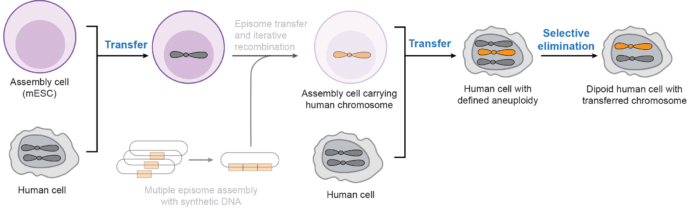
Synthetic genomes created to date – for the bacteria E. coli and Mycoplasma – were assembled in microbes. However, human chromosomes are too large to be assembled in this way. Therefore, an entirely new pipeline is required for the SynHG project. This new research paper outlines this pipeline and demonstrates the critical first step in it: the transplantation of human chromosomes into an ‘assembly cell’, exemplified by a mouse embryonic stem cell (mESC). In the mESC the human chromosome can be manipulated and recoded without the complexities of working directly in a human cell, which contains two copies of each chromosome. The isolated chromosome can then be transferred back from the mESC to a recipient human cell and the corresponding ‘spare’ copy eliminated from the recipient, leaving the usual two copies. Crucially, the team demonstrated that this can be achieved without chromosome damage. In future work, this ‘assembly cell’ stage of the pipeline will be utilised to rewrite the genetic information on the human chromosome with synthetic sequence.
This experimental work was led by three researchers in the LMB’s PNAC Division: Gianluca Petris (now a Group Leader at the University of Udine and the Fondazione Italiana Fegato), postdoc Linda van Bijsterveldt and Simona Grazioli, a student and later a postdoc in the Division.
This achievement represents a crucial first step in the long journey towards a synthetic human genome. There remains a considerable amount of work required to develop artificial chromosomes, or complete synthetic genomes.
Integrated into the SynHG project is a major study on the social science and ethics of large genome synthesis led by Joy Zhang at the Centre for Global Science and Epistemic Justice at the University of Kent. This ‘Care-full Synthesis’ arm of the project is working with civil society partners worldwide to proactively assess and respond to the socio-ethical implications of the developing tools and technologies.

This work was funded by the Wellcome Trust and the UK Medical Research Council with additional support from the Boehringer Ingelheim Fonds, the Cambridge Commonwealth, European and International Trust and Marie Skłodowska-Curie Actions.
Further references
High-fidelity human chromosome transfer and elimination. Petris, G., Grazioli, S., van Bijsterveldt, L., Murat, P., Liu, K.C., Birnbaum, J., Sale, J.E. and Chin, J.W. Science
Jason’s group page
Julian’s group page
SynHG: Pioneering the principles of human genome synthesis
New project to pioneer the principles of human genome synthesis – Wellcome Trust press release
How to build a synthetic human chromosome by Roger Highfield (Science Museum)