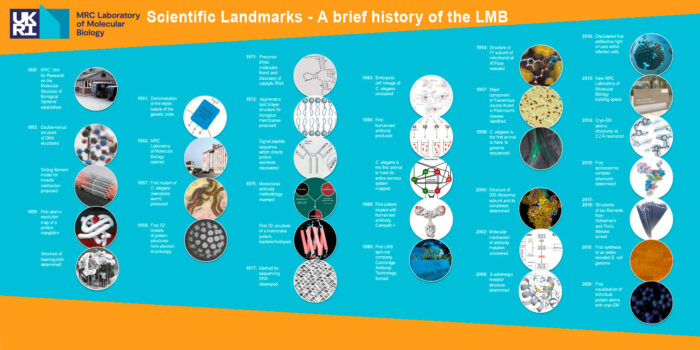
History of the LMB
In 1947 the Medical Research Council set up a ‘Unit for Research on the Molecular Structure of Biological Systems’ to enable Max Perutz and John Kendrew to develop their work using X-ray diffraction to study proteins.
The unit quickly diversified into other areas, including the structure of DNA, mechanism of muscle contraction, and structure of viruses, and became one of the birthplaces of modern molecular biology. This work was done while the unit was housed in the Physics Department at the Cavendish Laboratory.
The MRC, realising the potential for medical applications of these developments, provided a new building for the unit, and in 1962 the Laboratory of Molecular Biology was opened. Since then, the Laboratory has been a prolific source of new ideas, discoveries and inventions, establishing its reputation as a leading international research centre.
The Laboratory has won 12 Nobel Prizes for key discoveries and research undertaken in Cambridge.
Discoveries made at LMB have also formed the basis of many biotechnology companies, including Domantis, Cambridge Antibody Technology, Ribotargets, Protein Design Labs, Celltech, and Biogen.
LMB History Timeline
- 1947
- MRC ‘Unit for Research on the Molecular Structure of Biological Systems’ established
- 1953
- Double-helix structure of DNA elucidated
- 1953
- Sliding filament model for muscle contraction proposed
- 1957
- Single amino acid change causes sickle cell anaemia
- 1958
- Nobel Prize for Chemistry: Fred Sanger
- 1959
- First atomic resolution map of a protein, myoglobin
- 1959
- Structure of haemoglobin determined
- 1961
- Demonstration of the triplet nature of the genetic code
- 1962
- LMB Building opened
- 1962
- Nobel Prize for Physiology or Medicine: Francis Crick and Jim Watson
- 1962
- Nobel Prize for Chemistry: John Kendrew and Max Perutz
- 1967
- First mutant of nematode worm, C. elegans, produced
- 1968
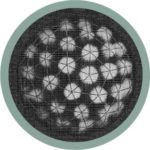
- First 3D models of protein structures from electron microscopy
- 1971
- Precursor tRNA molecules found and discovery of catalytic RNA
- 1972
- Asymmetric lipid bilayer structure for biological membranes proposed
- 1972
- Signal peptide sequence which directs protein secretion discovered
- 1975
- Monoclonal antibody methodology invented
- 1975
- First 3D structure of a membrane protein, bacteriorhodopsin
- 1977
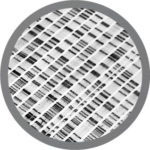
- Method for sequencing DNA developed
- 1980
- Nobel Prize for Chemistry: Fred Sanger
- 1982
- Nobel Prize for Chemistry: Aaron Klug
- 1983
- Embryonic cell lineage of C. elegans unraveled
- 1984
- Nobel Prize for Physiology or Medicine: César Milstein and Georges Köhler
- 1985
- Zinc finger DNA-binding motif proposed
- 1986
- First humanised antibody produced
- 1986
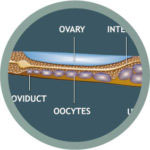
- C. elegans is the first animal to have its entire nervous system mapped
- 1987
- Commercial production of MRC confocal microscope
- 1988
- First patient treated with humanised antibody, Campath-1
- 1989
- First LMB spin-out company Cambridge Antibody Technology formed
- 1989
- Queen’s Award for Technology for peptide synthesizer
- 1991
- Queen’s Award for Technology for confocal microscope
- 1994
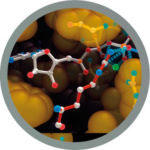
- Structure of F1 subunit of mitochondrial ATPase revealed
- 1997
- Nobel Prize for Chemistry: John Walker
- 1997
- Major component of filamentous lesions found in Parkinson’s disease identified
- 1998
- C. elegans is the first animal to have its genome sequenced
- 2000
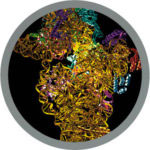
- Structure of 30S ribosomal subunit and its complexes determined
- 2002
- Nobel Prize for Physiology or Medicine: Sydney Brenner, Bob Horvitz and John Sulston
- 2002
- Molecular mechanism of antibody mutation uncovered
- 2008
- β-adrenergic receptor structure determined
- 2009
- Nobel Prize for Chemistry: Venki Ramakrishnan
- 2010
- Discovered that antibodies fight viruses within infected cells
- 2013
- New MRC Laboratory of Molecular Biology building opens
- 2013
- Nobel Prize for Chemistry: Michael Levitt
- 2014
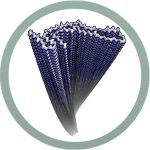
- Cryo-EM atomic structures at 3.2Å resolution
- 2015
- First spliceosomal complex structures determined
- 2017
- Nobel Prize for Chemistry: Richard Henderson
- 2017-18
- Structures of tau filaments from Alzheimer’s and Pick’s disease solved
- 2018
- Nobel Prize for Chemistry: Greg Winter
- 2019
- First synthesis of an entire recoded E. coli genome
- 2020
- First visualisation of individual protein atoms with cryo-EM
Download A brief History of the LMB Poster